Words we use
Every place has its own vocabulary, and this one has more than most. Some of it is Sussex, some of it is seaside, and some of it is the particular language of an association that has been looking after private roads since 1937.
None of it is meant to keep anybody out. If you have just moved here and somebody mentions the twitten behind the greensward, this page is for you.
Words from round here
Twitten
A narrow path between two walls or hedges. We have five of them, running between the gardens, and the Association maintains them. They are named and photographed on twittens and roundabouts.
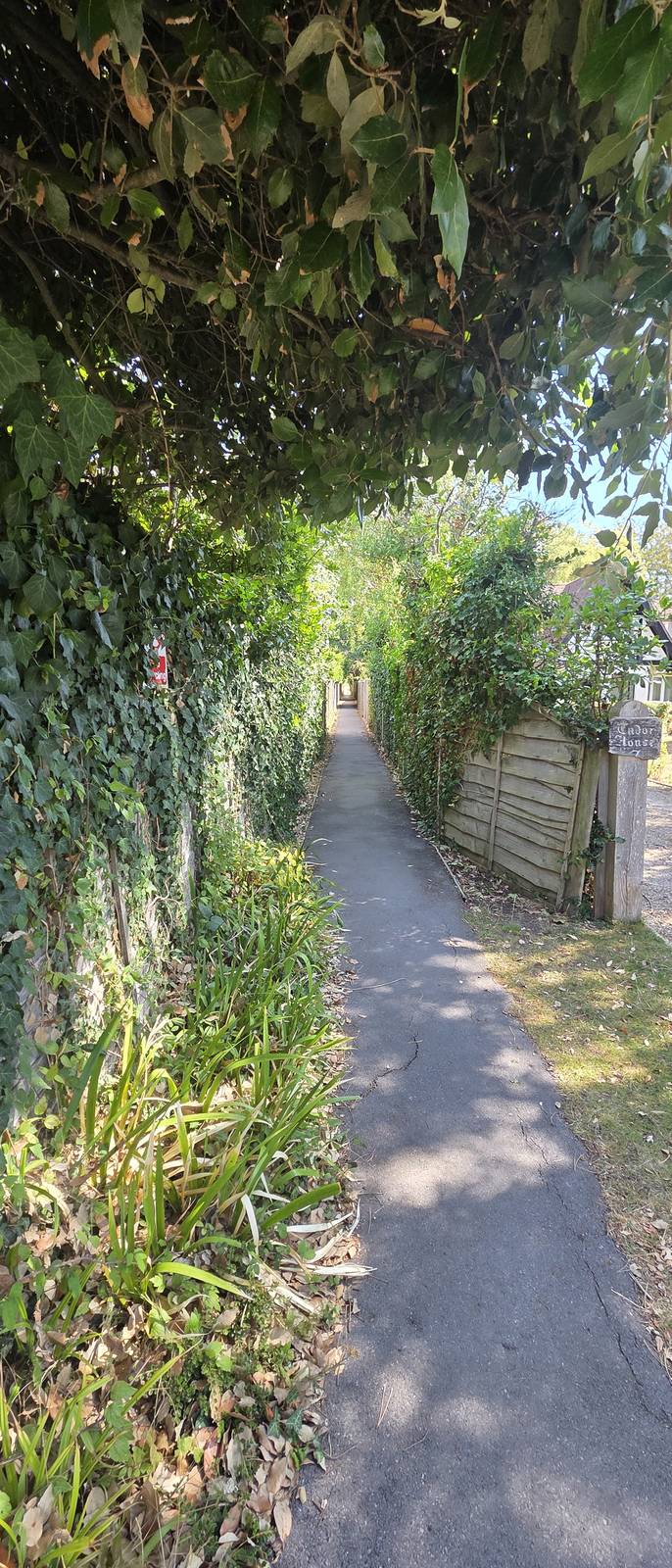
It is a Sussex word. You will hear it across the county and in parts of Kent, and almost nowhere else. People who move down from London tend to meet it in their first week and quietly wonder whether they have misheard.
The origin is usually traced to the Low German twiete, meaning an alley or a narrow lane, which would have arrived on this coast the way a good many words did, by boat. That derivation is widely repeated and it is plausible, but it is not certain, so treat it as the likely story rather than a settled fact.
A practical note while you are here: please do not cycle through ours. They are narrow, they have blind corners, and somebody is always coming the other way on foot.
Greensward
The open grass along the sea front, between the houses and the shingle. It belongs to the Association, it is a Site of Nature Conservation Importance, and it is where the beach huts, the slipway and the annual beach clean are.
Here is the thing most people get wrong about this word, and we did too. It is not a local coinage. Greensward is ordinary English, just very old ordinary English, and it has simply fallen out of everyday use nearly everywhere except in place names and in a few seaside towns like this one.
Sward on its own means the grassy surface of ground, the turf. It comes from the Old English sweard, which originally meant skin or rind. The same root gives us the rind on a piece of pork. So a sward is, quite literally, the skin of the earth, and a greensward is the green skin of it.
Farmers still talk about a grass sward without thinking twice. The rest of us gave the word up somewhere around the nineteenth century. It survives here because we have had one to talk about for a hundred years.
Groyne
A low wall running down the beach and out into the sea, built to trap shingle and stop it drifting along the coast. Ours are mostly timber, and Arun District Council maintains them.
The word comes from the Old French groign, a snout, which is what a groyne does if you look along the beach: it sticks out.
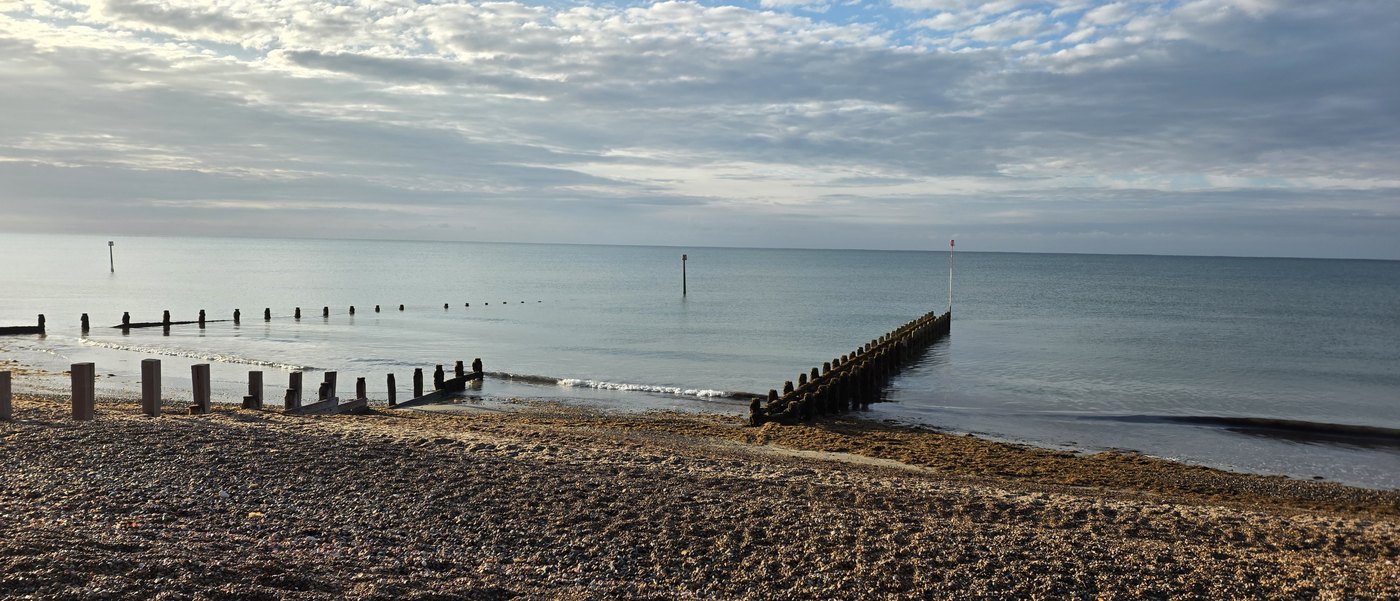
Without them the shingle would migrate steadily eastward and the sea would be a great deal closer to the houses than anybody would like. See coast and sea defences.
Shingle, foreshore and rock armour
Shingle is the pebble beach, as opposed to sand. Ours is what stands between the estate and the Channel.
The foreshore is the part of the beach between the high and low water marks, the bit that is beach twice a day and sea twice a day.
Rock armour is the large boulders placed along the defences to break up wave energy before it reaches the wall. You will have seen them arriving by lorry and crane. They are not decorative.
Words the Association uses
Less charming, more useful. These are the ones where not knowing can cost somebody money.
Verge
The strip of grass between the road and your boundary.
Ours, not yours, which surprises people. We ask you to look after the stretch outside your house, and there is a reason beyond tidiness: that grass edge is what carries rainwater off the road. Cut it back to the tarmac and the water has nowhere to go but into the road surface, which is the expensive part.
See roads and verges.
Adopted and unadopted
An adopted road is one the council has taken on and maintains at public expense. An unadopted road is not.
Ours are unadopted. That is the single most important fact about living here: nobody else is coming to resurface them. See what you pay for.
Covenant
A restriction written into the deeds of a property, binding on whoever owns it, now and later.
Covenants are why the house next door will still be a house in twenty years and not a car park. They vary between properties here, so the only reliable answer for yours is in your own deeds. See covenants.
Deed of Grant, and easement
An easement is a legal right to use somebody else’s land for a particular purpose, such as crossing it to reach your own.
A Deed of Grant is the document that creates one. If you widen your driveway across a verge the Association owns, this is the paperwork involved, and it is drawn up at the owner’s expense. See altering your driveway.
Road group, and Road Representative
The estate is divided into five road groups for managing work and money: Old Point, Sea Way, the Sea Lane Estate, Merry End and The Byway.
Each has a Road Representative, a volunteer neighbour who looks after that road, collects its charges, welcomes new residents and is your first contact for almost anything. Find yours.
Ring-fenced fund, and special levy
Each road group’s money is ring-fenced, meaning it is kept for that road and cannot be spent elsewhere.
If a road’s fund cannot cover necessary work, a special levy is a one-off additional charge on the properties in that road group, agreed with the Management Committee after consulting residents.
Area of Special Character
Arun District Council formally recognised this estate and part of the village as an Area of Special Character in 1996, at the Association’s request. The current Local Plan calls it an Area of Character.
It is not a Conservation Area, and the controls are lighter than people often assume. What it does do is give weight to the Village Design Statement when the council decides a planning application.
Permitted development
Building work you can carry out without applying for planning permission, set out in government legislation.
Those rights do still apply here, which surprises some people. We ask you to follow the Village Design Statement anyway, because the character of the estate does not protect itself. See building work and planning.
Soakaway and culvert
A soakaway is a pit or trench that lets rainwater drain away into the ground rather than run off into the road. Several roads here have no surface water drain at all and rely on them entirely.
A culvert is a pipe carrying a watercourse under something, usually a road or a driveway. Properties fronting Sea Lane have ditches or culverts along the front, and there is a common law duty to keep them clear. See drainage.
Trustee, and unincorporated
An unincorporated association is one that is not a company and has no legal personality of its own. It therefore cannot own land in its own name.
So MOSA holds its land through Trustees, who own the legal estate on behalf of members. This is the arrangement the move to a company structure is intended to simplify. See trustees.
Managing agent
A firm engaged to handle the day-to-day business of an estate: invoicing, payments, formal notices. See who handles what for who ours are.
The Association is not a managing agent and the managing agents are not the Association. If you are unsure which of us you need, see who handles what.