History of the estate
Modern Middleton on Sea began with one man and a large field.
After the First World War, Captain Rowlands Coldicott bought much of the farmland of Manor Farm, running between Middleton Road, Sea Lane and the sea. He started by building detached houses along Sea Lane, then laid out two branch roads roughly parallel to the coast: Sea Way to the west, Old Point to the east.
The first plots in Sea Way sold in 1920. By 1928 more than a hundred houses had been built, many roofed in handmade tiles and thatch.
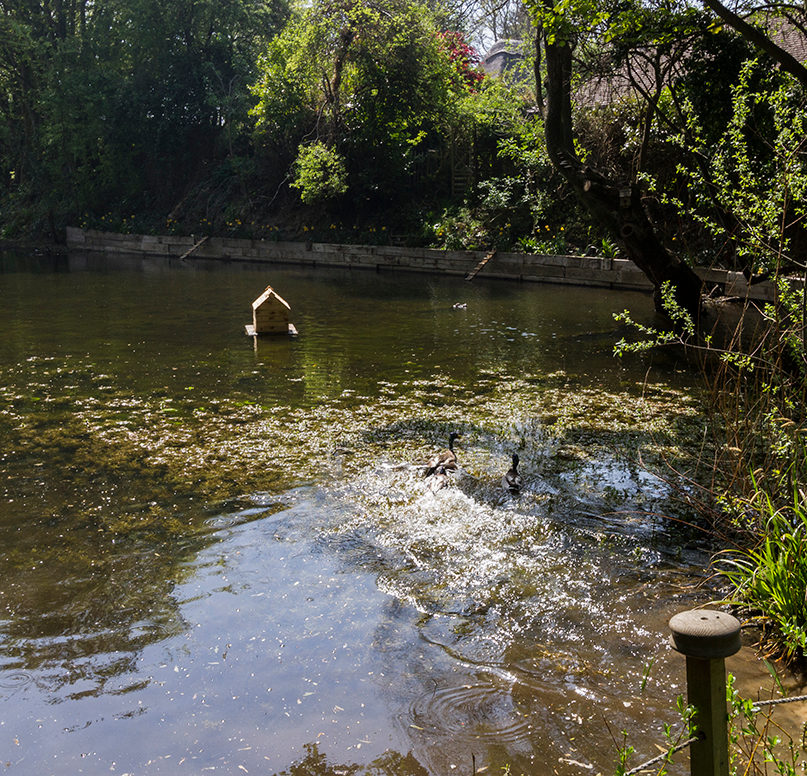
What was here before
The word “modern” in that first line is doing some work.
There was a Middleton before Coldicott, and most of it is under the sea. Sea Lane was the village street, and the medieval church of St Nicholas stood south of where the lane now ends, beyond the present shoreline. In 1606 it was about 170 yards from the high tide mark. By 1724 it was twenty. By 1789 the sea was a few feet from the walls, graves had gone and bones were washing up on the beach. A very high tide early in 1838 finished it.
Charlotte Smith wrote a sonnet about it that year, and it is still taught.
The village the sea took has the whole of it: the dates, the poem, and why the sea defences are not really maintenance.
One house from that generation still stands on Sea Lane.
Flint Cottage
Flint Cottage, number 38 Sea Lane, is Grade II listed. It dates from the middle of the nineteenth century, which places it within a decade or two of the loss of the old church, and it was probably built as a pair of cottages rather than as one house.
It is faced with flint, once painted, with long and short painted brick dressings and quoins, an eaves cornice and a half-hipped slate roof. The original glazing bars are still in the windows.
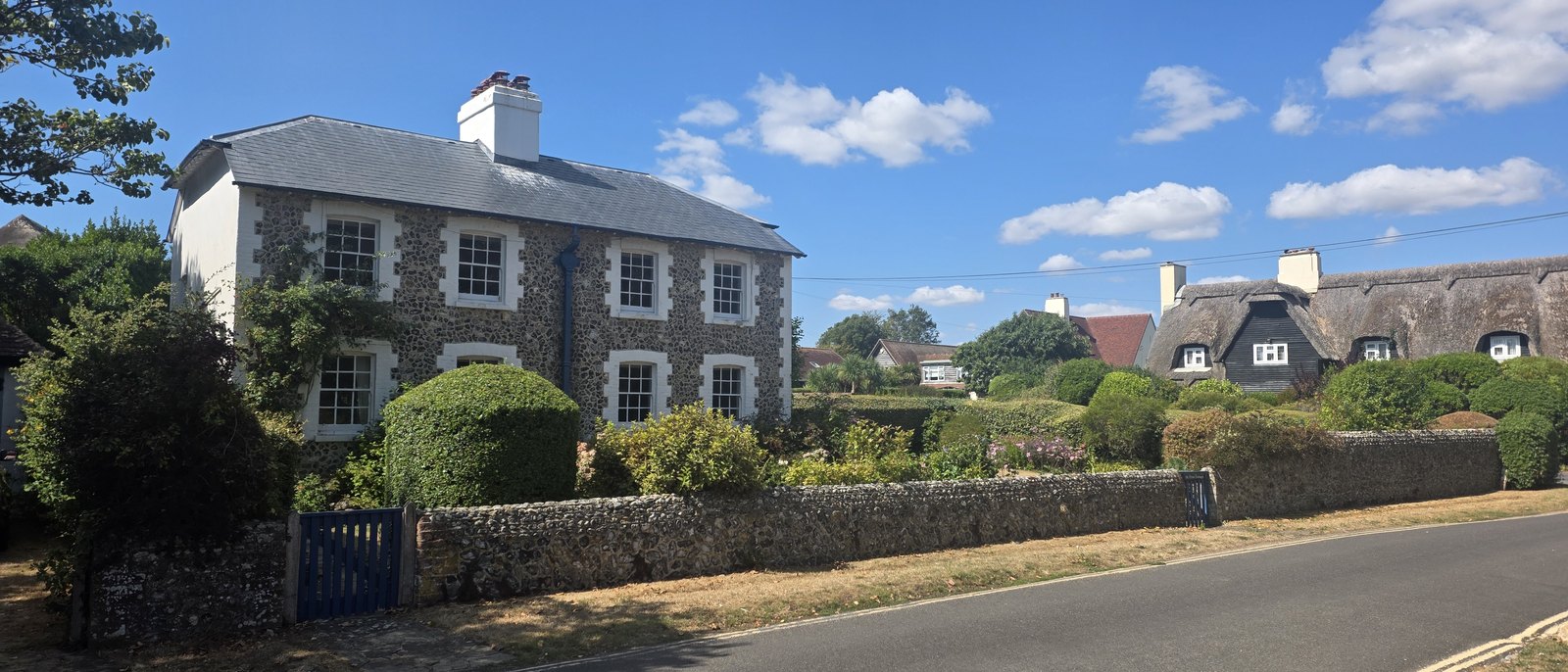
The listing records one thing that is easy to walk straight past. The rainwater head carries a figure of an owl with its wings spread, a mouse in its claws, and a leopard’s head on either side. Historic England thinks it is probably modern rather than original. Either way it is worth looking up for.
It is somebody’s home, so admire it from the lane.
Sources: the National Heritage List for England, entry 1027611 (opens in a new tab), listed 20 September 1984; and the Victoria County History of Sussex, volume 5 part 1, which records that a pair of mid nineteenth century flint estate cottages still stood in Sea Lane in 1991.
A village, not an estate
Coldicott was after something more ambitious than a housing development. He wanted a village suited to the seaside, with its own shops and places to spend an afternoon. He kept the Greensward open along the front and put rows of beach huts on it.
His preference for spacious layouts and traditional materials is why the place still feels the way it does. More private roads followed, The Byway and Merry End leading off Middleton Road, which was itself lined with houses and shops.
He also built several properties in Sea Close. The central part of the 60-acre field west of Sea Lane went to the Linfoot family, who developed South Walk, East Close and West Close. Strictly speaking that is the 'Sea Lane Estate’, though most people now use the name for the whole place.
People who lived here
Two men who lived in Middleton on Sea are worth knowing about, and one of them is a coincidence nobody could have arranged.
William Page moved here in 1922 and died here in February 1934. He was the general editor of the Victoria County History, the great county-by-county survey of English local history, which he ran for thirty years and which published eighty-nine volumes under him. He had a wooden building put up on his property to hold fourteen tons of research material.
Which means that the standard published history of this parish, the one the village the sea took leans on, was edited by a man living a few hundred yards from the place it describes.
Charlie Kunz died at his home here on 16 March 1958. An American-born pianist who became one of the best-known musicians in Britain, he was billed as the Medley King, sold records by the lorry-load in the 1930s and 1940s and was a fixture on the wireless.
Other names come up locally, including a music-hall comedian and more than one household name from television. We have not been able to confirm those, so they are not here yet.
The Association
When Coldicott came to retire, he was anxious that somebody should carry on what he had started.
What the Association has done since
Coastal defence has been a priority throughout. After the Second World War the Association worked with local councils to protect the shoreline. A Coastal Sub-Committee was formed in 2000 to monitor erosion and keep the sea defences in front of the authorities.
The beach huts. In 1978 the Association set up Middleton-on-Sea (Beach Huts) Limited, a separate company, to buy the land when there was a real prospect of it being sold for development and to manage the huts thereafter.
Area of Special Character. In 1996, at the Association’s request, Arun District Council formally recognised the estate and part of the village as an Area of Special Character. The Association then compiled the Village Design Statement, which the council adopted as supplementary planning guidance.
Almost everything above was done by residents, unpaid, in their own time.